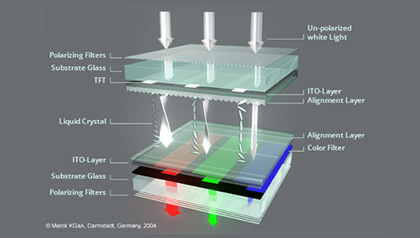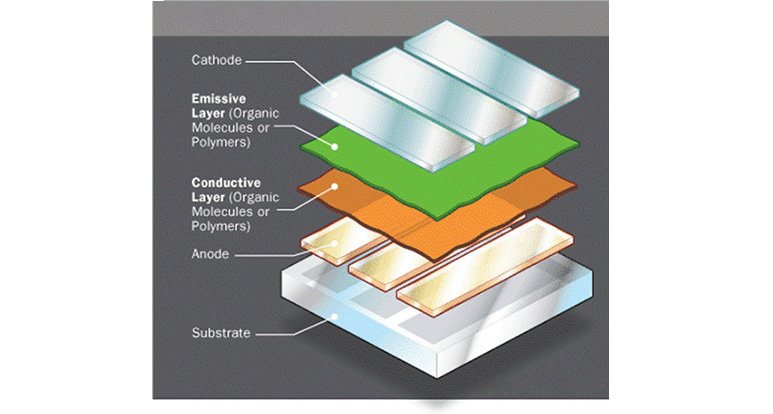


OLED (Organic Light Emitting Diode) technology uses organic light-emitting diodes arranged in ultra-thin films that generate their own light within displays. OLEDs are used in both display panels and large-area lighting systems. Their thin and flexible layers also allow the production of foldable and rollable screens.
LED, OLED, and LCD: Main Differences
Traditional LEDs, based on inorganic materials, were initially used as indicator lights or in small displays. As their brightness improved, they began to be used for general lighting and as backlights in LCD panels. OLED displays, on the other hand, represent a technological evolution: they emit their own light, eliminating the need for backlighting, and are produced through entirely different manufacturing processes compared to conventional LEDs.
Thin-Film Technology
The key feature of OLEDs is the use of extremely thin semiconductor layers—ranging from a few nanometers to a few micrometers—which allows the creation of very slim and lightweight displays.
Advantages of OLEDs
- Self-emissive light generation eliminates backlighting, reducing energy use and production costs.
- Very high contrast ratios and deep blacks, thanks to independent pixel control.
- High energy efficiency and extremely fast response times.
- Wide viewing angles and superior image quality compared to LCDs.
Disadvantages of OLEDs
- Production costs remain high.
- Sensitive to humidity and temperature changes, requiring strong encapsulation.
- Lower brightness compared to inorganic LEDs.
- Lower luminous efficiency when used as a light source.
- Possible degradation over time, leading to “dark spots” on the screen.
Organic Structure and Color
The term “organic” refers to the carbon-based materials used in the semiconductors. Red, green, and blue OLEDs are made from different compounds, each with a distinct lifespan, which can cause color shifts in displays over time.
Electrical Control
Although self-luminous, OLED displays require more complex and higher electrical power control than LCDs, which rely on external backlighting. In summary, OLEDs are an advanced display technology offering superior image quality and innovative design possibilities, though some limitations still remain to be overcome.